
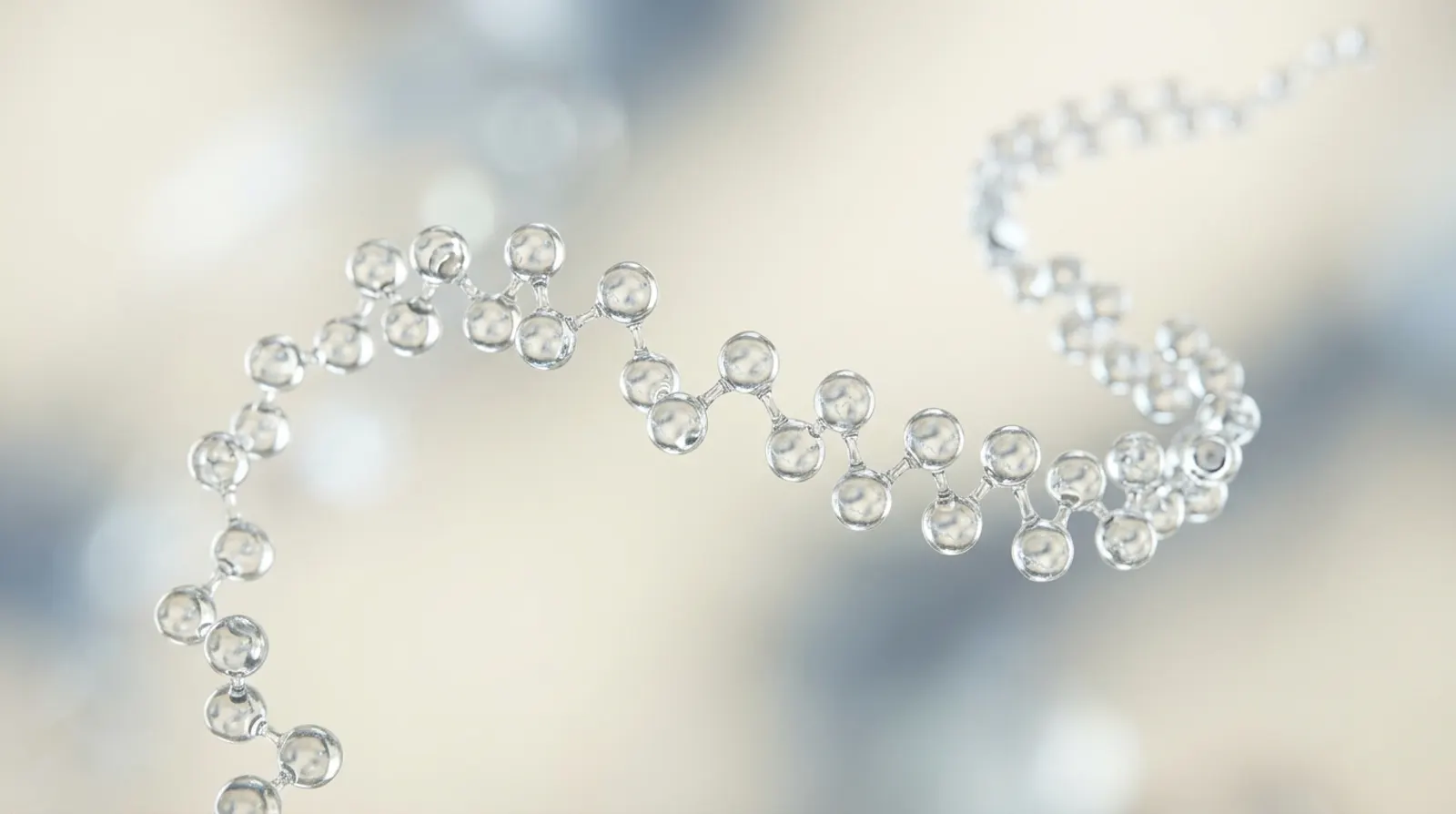
What are peptides? (The honest version)
Peptides are short chains of amino acids — typically 2 to 50 — linked by peptide bonds. Your body makes thousands of them as signaling molecules: insulin, the gut hormones behind Ozempic, and many brain and skin messengers are all peptides. The word describes a molecule's size, not a benefit — a peptide can be a life-saving approved drug, a cosmetic ingredient, a food-derived supplement, or an unapproved compound with no human evidence at all. Sorting out which is which is what this page is for.
A few quick facts
Short amino-acid chains
Typically 2–50 amino acids — smaller than full proteins.
Signaling role
Many act as messengers between cells in the body.
Naturally occurring
Your body produces thousands of different peptides.
Regulation varies
Some are FDA-approved drugs; many are research-stage only.
The science: amino acids, peptide bonds, and chain length
Every peptide starts with amino acids — the same 20 building blocks your body uses for everything from muscle to enzymes. A peptide bond forms when the carboxyl group of one amino acid links to the amino group of the next, releasing a water molecule. Repeat that link and a chain grows.
Chemists name the chain by its length. Two amino acids make a dipeptide; up to about twenty is an oligopeptide; longer chains are polypeptides; and somewhere past fifty, once the chain folds into a stable three-dimensional shape, convention starts calling it a protein. The boundaries are fuzzy and honestly a little arbitrary — what matters is that length changes behavior:
Short chains are small enough to float between cells and fit precisely into receptors, which is why so many of the body's messengers are peptides. Long folded chains — proteins — do structural and mechanical work instead. Same material, different scale, different job.
The sequence is everything. Swap one amino acid and the peptide may bind a different receptor, survive longer in the bloodstream, or do nothing at all. Semaglutide, for example, is the natural gut hormone GLP-1 with a handful of deliberate substitutions that stretch its lifespan in the body from minutes to days. That precision is what makes peptides interesting to medicine — and what makes "peptide" as a marketing word almost meaningless, because the sequence, not the category, determines what a molecule does.
What do peptides actually do?
Mostly, they carry messages. A peptide travels until it meets a cell displaying the matching receptor, binds it like a key in a lock, and the cell changes what it's doing — releases a hormone, dials metabolism up or down, starts a repair program. Insulin telling cells to absorb glucose is the textbook example; GLP-1 telling the brain you're full is the one reshaping medicine right now.
Your body runs thousands of these signals continuously: gut peptides governing appetite and digestion, brain peptides shaping mood and pain, immune peptides that kill microbes directly, skin peptides involved in repair. This is why peptides make compelling drug candidates — the signaling system already exists, and a designed peptide can speak its language.
It's also why the delivery route matters so much. Your digestive system exists to dismantle amino-acid chains, so most peptides don't survive being swallowed — which is why peptide drugs are typically injected, and why an oral version of semaglutide required its own engineering workaround. When a product claims a peptide works fine as a capsule or a cream, "would it survive digestion, and can it reach its receptor?" is a question the marketing should have to answer. Questions about any specific product's route belong with a pharmacist or prescriber — not a sales page.
What are peptides used for?
"Peptide" covers several very different worlds, and each carries its own evidence standard. Sorting a product into the right world is most of the work of evaluating it:
Approved medicine
Insulin, the GLP-1 class and dozens of other peptide drugs treat diabetes, obesity, osteoporosis and more — with controlled trials, defined dosing and prescriber oversight. This is the strongest evidence tier peptides reach.
Compounded prescriptions
Licensed pharmacies can prepare certain peptides for individual patients under a prescriber's order. Evidence varies by compound, and FDA periodically restricts which ones are eligible — the channel is lawful, the evidence still needs checking per compound.
Skincare and cosmetics
Topical peptides like copper tripeptides appear in creams and serums under cosmetic regulation — supported by small appearance-focused studies, not drug-level trials.
Dietary supplements
Collagen peptides and similar oral products are sold as food-derived supplements. Evidence exists for some uses and is modest; supplement regulation does not verify efficacy.
Research compounds
Many peptides famous online — healing, longevity, cognitive — are studied mostly in animals and sold outside any approval pathway. Interesting biology, unestablished medicine.
The practical takeaway: never let one tier borrow another tier's evidence. A GLP-1 trial says nothing about a research compound, and a cosmetic study says nothing about an injection. Our legality guide maps these categories in detail.
The goals people chase — and what the evidence says
Almost everyone arrives at peptides through one of four goals. The honest evidence picture differs sharply between them:
Weight loss
The one goal where strong human evidence exists — for one specific family. FDA-approved GLP-1 receptor agonists produced meaningful average weight loss in large controlled trials, prescribed and monitored by clinicians. Other peptides marketed for fat loss ride on that family's reputation without its data.
Compare the GLP-1 classMuscle growth
The gap between search volume and evidence is widest here. The compounds marketed as muscle-building peptides — growth-hormone secretagogues and their relatives — are supported mostly by animal work and small mechanistic studies, not by trials showing meaningful muscle gain in healthy adults. Most are also prohibited in tested sport.
See the evidence per compoundSkin and anti-aging
Two different products share one word. Topical peptides in creams sit in cosmetic regulation with small appearance-focused studies. Oral collagen peptides have modest supportive trials for skin elasticity and hydration. Neither is drug-level evidence — and injectable 'anti-aging peptides' are a third, far less supported category.
Read the skincare explainersHealing and recovery
The internet's favorite recovery compounds are studied almost entirely in animals. The biology is genuinely interesting; the human trials mostly don't exist. Anyone quoting rat studies as if they settle human questions is skipping the hard part.
The honest BPC-157 review"Is ___ a peptide?" — quick answers
Ozempic (semaglutide)
A modified GLP-1 peptide — an engineered gut hormone.
Tirzepatide (Mounjaro, Zepbound)
A dual-receptor peptide in the same family.
Insulin
The original peptide drug — in use since the 1920s.
Collagen peptides
Fragments of collagen protein, sold as a supplement.
Growth hormone (HGH)
Technically a protein (191 amino acids) — marketing rounds it down.
Testosterone
A steroid hormone built from cholesterol — different chemistry entirely.
Peptides vs. proteins, hormones, and steroids
Peptides and proteins are the same material at different lengths: chains of amino acids, with "peptide" conventionally meaning roughly 2–50 links and "protein" meaning longer chains that fold into working machines. Size changes role — peptides usually carry messages; proteins usually do jobs.
"Hormone" describes a role, not a chemistry. Some hormones are peptides (insulin, GLP-1); others are steroids (testosterone, estrogen) built from cholesterol and chemically unrelated. When marketing blurs peptides and hormones into one story, it is usually borrowing credibility across that line.
Which answers a common search directly: peptides are not steroids. Different building blocks, different structures, different biology. The two get lumped together because both appear in performance and physique circles — a social overlap, not a chemical one.
| Peptide | Protein | Steroid | |
|---|---|---|---|
| Built from | Amino acids (2–50) | Amino acids (50+, folded) | Cholesterol backbone |
| Typical role | Cell-to-cell signal | Structure and machinery | Hormone signal |
| Examples | Insulin, GLP-1, BPC-157 | Collagen, enzymes, HGH | Testosterone, estrogen, cortisol |
| Survives digestion? | Usually not | Broken down to fragments | Often yes |
And a molecule being "natural" — something your body already makes — says nothing about whether a synthetic version, at a pharmacological dose, from an unregulated source, is safe or effective. That question is what clinical trials exist to answer.
Are peptides safe?
The only honest answer splits the question in two. Approved peptide drugs have characterized risks: their side effects were measured in trials, appear on the label, and are managed by a prescriber who knows your history. Common examples in the GLP-1 class — nausea, digestive effects — are well documented precisely because the trials existed to document them.
Unapproved peptides bought online are a different question entirely. Their risks aren't documented as acceptable — they're largely unmeasured. No required purity testing, no verified dose, no trial data on long-term effects, no one accountable for what's actually in the vial. Analyses of gray-market products have repeatedly found mislabeled contents and contamination. "No reported side effects" in that world mostly means no one was required to look.
Two practical rules follow. First, evidence tier and source determine safety more than the molecule's name does — the same sequence can be a pharmacy-grade prescription or an unverified powder. Second, individual context matters: medications, pregnancy, chronic conditions change the answer, which is why the question belongs with a licensed provider who knows yours. Our readiness check helps structure exactly that conversation, and the clinic-vetting guide covers how to evaluate anyone offering peptides.
What is "peptide therapy"?
As clinics use the phrase, peptide therapy means a program built around prescribed peptides: a licensed provider evaluates you, orders baseline labs, and — if appropriate — writes a prescription filled by a licensed compounding pharmacy, with follow-up along the way. That prescriber-and-pharmacy chassis is what separates an actual medical program from a website selling vials.
What a program may lawfully offer changes over time, because FDA periodically restricts which compounds pharmacies can prepare. Whether a specific peptide is currently available through legitimate channels is a question for the prescriber and pharmacy — and a clinic that answers it with marketing instead of a straight answer is telling you something.
If you're evaluating programs, start with how to choose a peptide clinic and what peptide therapy actually costs. In the Houston area, we also keep an independent local guide.
Questions worth asking
If you are considering any peptide, bring these questions to a licensed healthcare provider before making a decision:
- Is this peptide FDA-approved for any use? If so, for what?
- What does the published human evidence actually show?
- What are the known side effects and unknowns?
- Could this interact with my current medications or conditions?
- Where is the product manufactured and who tests its purity?
- What follow-up or monitoring is recommended?
- What outcomes can — and can't — I reasonably expect?
- What would make us stop or change course?
References and source links for individual peptides appear on each entry in the Peptide Library and in our blog posts. For the practical questions — cost, legality, storage, choosing a provider — see the guides.
Frequently asked questions
What are peptides in simple terms?
Short chains of amino acids — think of them as mini-proteins your body uses as chemical messengers. Insulin is a peptide; so are many gut, brain and skin signaling molecules. The word describes a molecule's size and shape, not a benefit.
What do peptides do in the body?
Mostly, they carry messages. A peptide binds a receptor on a cell's surface the way a key fits a lock, and the cell changes its behavior — releasing insulin, signaling fullness, triggering repair processes. Your body makes thousands of different peptides, each with its own receptors and its own job.
Are peptides steroids?
No. They are chemically unrelated. Peptides are chains of amino acids; steroids are lipid molecules built on a cholesterol backbone. Some peptides and some steroids are both used as hormones, which is where the confusion starts — but 'peptides are like steroids' is a chemistry error, whichever way it's meant.
What is a peptide bond?
The chemical link that joins one amino acid to the next — formed between the carboxyl group of one and the amino group of the following one, releasing a water molecule. String amino acids together with peptide bonds and you get a peptide; keep going long enough and you get a protein.
What are peptides used for?
It depends entirely on the peptide. Approved peptide drugs treat diabetes, obesity and other conditions; cosmetic peptides appear in skincare; collagen peptides are sold as supplements; and many compounds sold as 'peptide therapy' are unapproved and mostly studied in animals. Each use case carries a different evidence tier.
Is Ozempic a peptide?
Yes. Ozempic's active ingredient, semaglutide, is a modified GLP-1 peptide — an engineered version of a gut hormone your body already makes. Tirzepatide (Mounjaro, Zepbound) is also a peptide. The most heavily prescribed 'peptide drugs' in the world right now are this family.
Do peptides help you lose weight?
One specific family — the FDA-approved GLP-1 receptor agonists — produced meaningful average weight loss in large trials for qualifying patients under medical care. That evidence does not transfer to other peptides marketed for weight loss, whose human support is thin to absent.
Are peptides safe?
Approved peptide drugs have characterized risks managed by prescribers. Unapproved peptides bought online have uncharacterized risks and no oversight — safety simply hasn't been established, which is not the same as being safe.
Are peptides good for you?
The category is too broad for one answer — like asking whether 'pills' are good for you. A specific peptide, for a specific person, for a specific purpose, at a specific evidence tier can be evaluated. The category can't. Anyone answering yes for all peptides at once is selling something.
Which peptides are FDA approved?
Dozens of peptide drugs hold approvals — insulin and the GLP-1 class are the familiar examples. Approval attaches to a specific product for a specific condition, so the useful question is always about the exact product and source in front of you.
Are peptides the same as proteins?
Same building blocks, different size: peptides are short chains (roughly 2–50 amino acids), proteins are long folded ones. Size changes behavior — peptides often act as signals, proteins as machinery.
Keep reading
Want the short, no-hype version?
Get the free Peptide Guide + Red-Flag Checklist — plain-English education only.