
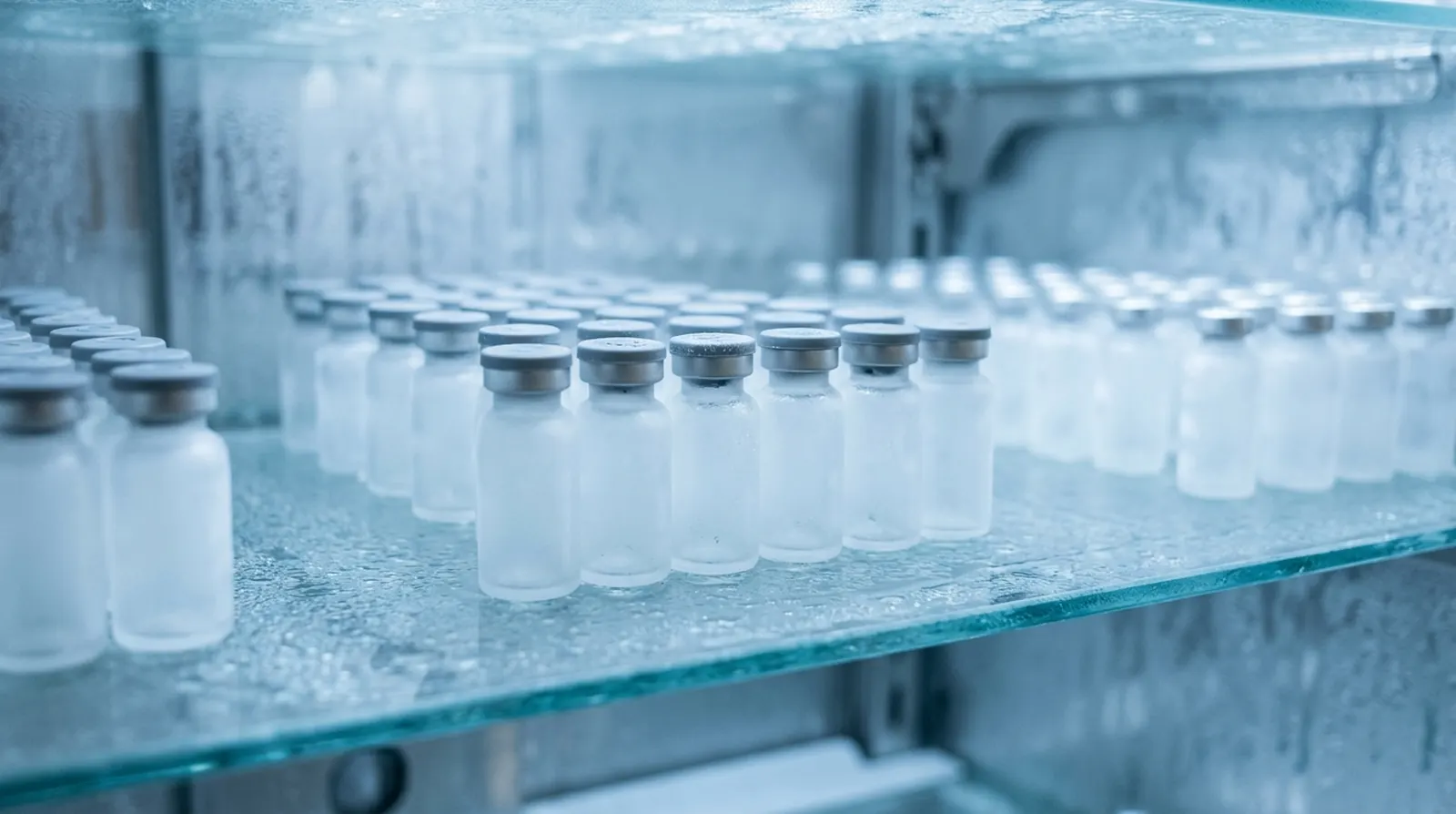
Do Peptides Need to Be Refrigerated? Storage and Stability
Peptides are chains of amino acids, and chains break. Heat, light, agitation and time all degrade them — which is why storage instructions are not fine print but part of whether the product in the vial is still the product on the label.
This guide explains the principles in plain English. It is not an instruction sheet for any specific product: the label on a prescribed peptide and the pharmacist who dispensed it always outrank anything general you read online, including this.
Why peptides degrade
A peptide's activity depends on an intact sequence and, often, a folded shape. Chemical reactions that clip the chain or alter its residues accelerate with temperature, and some are catalyzed by light or by the repeated shear of shaking. Degradation is gradual and invisible — a vial does not look different at 80% potency.
That invisibility is the whole reason storage discipline exists: you cannot inspect your way to knowing whether a peptide is still good.
Powder versus reconstituted: two different clocks
Peptides are typically supplied as lyophilized (freeze-dried) powder because the dry state is far more stable — manufacturers commonly refrigerate it for long-term storage, and its shelf life is measured in months to years when kept cold, dark and sealed.
Once mixed into solution, the clock changes completely. Water enables the degradation chemistry, and a reconstituted peptide is a short-lived product measured in days to a few weeks under refrigeration, depending on the compound and the diluent. The two states should never be reasoned about interchangeably.
What the beyond-use date means
Compounded prescriptions carry a beyond-use date (BUD) assigned by the pharmacy under USP standards — the date after which the preparation should not be used, based on its formulation, container and storage conditions. It is deliberately conservative and it is specific to that preparation.
The BUD on your label is the answer to 'how long does this last?' for your product. A general figure from the internet — including any figure on this page — is context, not permission to exceed it.
Storage questions worth asking a pharmacist
If you are prescribed a peptide, the dispensing pharmacy is the authoritative source for its handling. Five questions cover nearly everything:
- How should this be stored before and after reconstitution?
- What is the beyond-use date, and what conditions does it assume?
- Does light exposure matter for this compound?
- What temperature excursions are acceptable — for example, in transit?
- How should I recognize and handle a product I suspect was stored improperly?
Frequently asked questions
Do peptides need to be refrigerated?
Generally yes for reconstituted peptides, and refrigeration is commonly recommended for long-term storage of the dry powder as well. The specific product's label and the dispensing pharmacist outrank any general rule.
How long do reconstituted peptides last in the fridge?
Typically days to a few weeks depending on the compound, diluent and preparation — which is why compounded prescriptions carry a pharmacy-assigned beyond-use date. That date, not a general figure, is the answer for your product.
Can a degraded peptide be identified by looking at it?
Usually not. Loss of potency is invisible; visible changes like cloudiness or particulates mean something has already gone significantly wrong. Absence of visible change is not evidence of potency.
Does freezing help?
Freeze-thaw cycles can damage peptides in solution, and repeated cycling is a recognized stability risk. Dry powder is a different matter and is often stored frozen by manufacturers. For anything prescribed to you, follow the label and ask the pharmacy.